
Reviewed · HISTORICAL TOURS
Aberdeen’s Ancient Heritage and Folklore
The Picts left no grand capital or tidy museum trail. Instead, you find their story in windswept hillforts, carved stones, and lonely circles scattered across Aberdeenshire. This seven-and-a-half-hour trip links those places with the legends that grew around them, making ancient Scotland feel close to the ground beneath your boots.
I like the small maximum group of seven, which gives Jacqueline room to adjust the day to your interests. I also like the mix of serious archaeology and living folklore, from Pictish symbols at Rhynie to stories about kings, trade, belief, and the end of Pictish power.
The main catch is physical: several stops involve short but steep walks over uneven ground. Lunch is not included, and the tour depends on good weather, so you should bring sensible footwear, outdoor clothing, and a backup plan for your midday meal.
In This Review
- Key things to know before you book
- Why this tour feels different from a standard Aberdeen day trip
- Barra Hill and the first look at Pictish settlement
- Dunnideer Hillfort, castle ruins, and a stone circle
- Rhynie and the scale of the Pictish world
- Bellabeg and a practical country lunch
- Tomnaverie Stone Circle and the mystery of recumbent stones
- Jacqueline’s flexible guiding style
- Price, group size, and what you get for $135.49
- Walking, weather, and who should skip it
- Cancellation and meeting point details
- Should you book Aberdeen’s Ancient Heritage and Folklore?
- FAQ
- Where does the tour start?
- What time does the tour begin?
- Where does the tour end?
- How long does the tour last?
- What sites are visited?
- Is lunch included?
- How many people can join the tour?
- Is the tour suitable for people with mobility issues?
- Should I bring walking poles?
- What happens if bad weather cancels the tour?
Key things to know before you book
- Pictish sites away from the usual tourist route: Visit Barra Hill, Dunnideer, Rhynie, and other quiet corners of Aberdeenshire rather than only the region’s better-known castles.
- A very small group: The tour accepts no more than seven people, and Jacqueline can shape parts of the day around your interests when time and conditions allow.
- Real hill walking: Barra Hill and Dunnideer include uphill sections, with walking poles worth bringing if you use them.
- A rare stone circle type: Tomnaverie is a recumbent stone circle, a form found only in northeastern Scotland.
- Lunch is your responsibility: You can buy food in Insch or Bellabeg, bring a picnic, or use the provided cooler.
- A folklore-led approach: The day connects archaeology with stories about Pictish symbols, local beliefs, kings, and the change from Pictish culture to the kingdom of Alba.
Why this tour feels different from a standard Aberdeen day trip
Many Aberdeen excursions focus on grand architecture, coastal scenery, or whisky. This one takes you into older, quieter places where there may be little to see at first glance. A bank of earth, a few stones, or a rough hilltop can seem modest until someone explains what it meant to the people who built it.
That is the central strength of the day. You are not simply ticking off ruins. You are learning how early communities chose high ground, built defenses, marked burial places, traded across long distances, and passed beliefs through symbols and stories.
The small group matters here. With no more than seven people, the experience should feel closer to a private outing than a large coach trip. One solo participant had the day adjusted around personal interests, and another group was taken to additional places such as a sea cliff, a whisky brewery, and a castle. Those extras are not guaranteed, but they show the kind of flexibility Jacqueline may offer when the schedule, weather, and group interests permit it.
You should still see this as a full country day, not a quick city excursion. The meeting point is the William Wallace Statue on Union Terrace in Aberdeen at 9:00 a.m., and you return there at the end. The total duration is about seven hours and 30 minutes.
A few more Aberdeen trips to weigh up
- Aberdeenshire Private Half Day Castle & Historic Building Tour
★ 5.0 · 18 reviews - Aberdeen Historical Walking Tour
★ 5.0 · 13 reviews - Old Town Walking Tour History and Tales in Edinburgh
★ 5.0 · 2,168 reviews
Barra Hill and the first look at Pictish settlement
Barra Hill begins the historical story with a hillfort. These sites were built on higher ground, often using timber or stone enclosures to protect and organize settlements where people lived and worked.
The remains at Barra are foundations rather than intact walls. That may sound underwhelming if you are expecting a castle with towers and doorways, but the open setting helps you understand the choice of location. From elevated ground, early communities could watch the surrounding area and create a defensible home.
You get about an hour here, which gives the guide time to explain how archaeologists read banks, ditches, and faint traces in the earth. The Picts left few written records of their own, so much of what we know comes from archaeology, carved stones, later accounts, and careful interpretation.
The walk is one of the day’s first physical tests. The route can include steep sections, and uneven ground is part of the bargain. If you have walking poles, bring them. Some may be available to borrow, but it is better not to rely on that.
Dunnideer Hillfort, castle ruins, and a stone circle
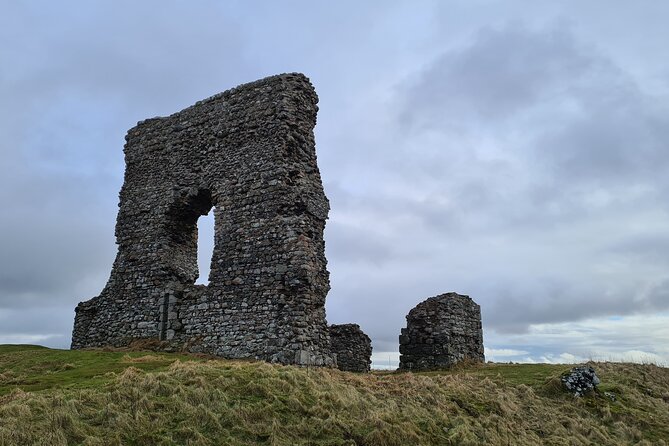
At Dunnideer, you take a short walk up a low hill toward the ruins of Dunnideer Castle. The tower house was built around 1260, partly using material from an earlier vitrified hillfort on the same site.
That layering is what makes the stop worthwhile. You are looking at medieval remains, but beneath them are much older defenses. The hillfort has at least five concentric rings of banks and ditches, which you can see from below and from the hilltop.
A vitrified fort is one where some stone has been subjected to intense heat, causing it to fuse or partly melt. The exact circumstances behind such remains can be difficult to establish, but the presence of the earlier fort gives the castle site a long human story rather than a single construction date.
Nearby are the remaining stones of Dunnideer Stone Circle. They add atmosphere, but do not expect a complete circle with every stone in place. Like many ancient sites in Scotland, this is a place where fragments and setting carry much of the interest.
You have around 30 minutes here. That is enough for the short walk and an explanation of the site, though anyone who wants a long period for quiet photography may find the stop brief.
Rhynie and the scale of the Pictish world
Rhynie is one of the most important stops for understanding the Picts in northeastern Scotland. The area was a stronghold, and nearby Tap O’Noth contains Scotland’s largest hillfort.
The hilltop settlement may once have supported more than 5,000 people. If that estimate is right, this was not a small isolated village. It was a major post-Roman settlement, large enough to challenge the idea that early Scotland was made up only of scattered farmsteads and tiny communities.
The tour does not simply point at a large hill and move on. At Rhynie, you look at a collection of Pictish carved stones and consider the symbols cut into them. Their exact meanings are not always certain, which is part of the appeal. A fish, animal, crescent, or abstract mark can open a discussion about status, belief, identity, and communication.
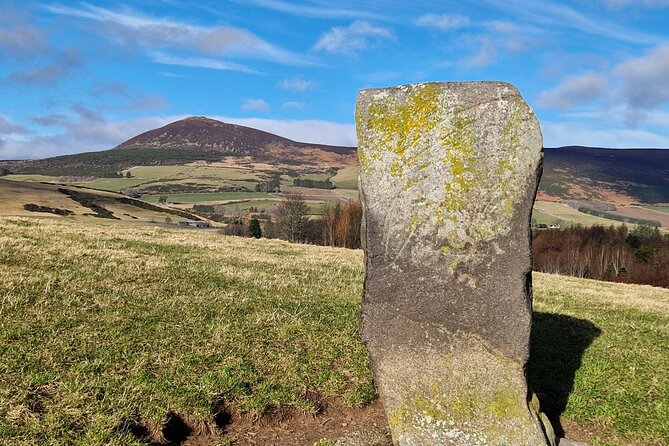
The Crawstane, a lone standing stone, once stood at the center of a settlement connected to trade across the Mediterranean. That detail changes how you picture the Picts. These communities were not cut off from the wider world. They had access to goods, ideas, and contacts that reached well beyond the northeast of Scotland.
You also hear about the King of the Scots and the cultural changes that helped bring about the decline of Pictish power. The story is not presented as a simple disappearance. Pictish identity and the emerging kingdom of Alba were part of a long process of political and cultural change.
This stop lasts about an hour. It is likely to be the most rewarding section for anyone who wants archaeology and early Scottish politics rather than only scenery.
Same glens and lochs, a completely different day out:
- Aberdeen City Centre Walking Tour (2pm)
★ 5.0 · 217 reviews - Dunnottar Castle and Royal Deeside Small-Group Tour from Aberdeen
★ 5.0 · 196 reviews - Loch Ness and the Highlands Small-Group Day Tour from Aberdeen
★ 5.0 · 164 reviews - North East Coastal Trail Small Group Day Tour from Aberdeen
★ 5.0 · 80 reviews
Bellabeg and a practical country lunch
The lunch break takes place at Lost, near the foot of the Doune of Invernochty motte and bailey castle. The small village sits in the Cairngorm National Park, with country lanes and a river setting suitable for a picnic or a short walk.
Lunch is not included, so plan ahead. You can buy food in Insch or Bellabeg, or bring your own picnic. A cooler is provided, which is useful if you are carrying food on a warm day.
This arrangement keeps the tour flexible, but it also means you should not arrive expecting a restaurant meal. Ask about the lunch plan before the morning begins, especially if you have dietary needs or prefer a proper sit-down meal.
The 45-minute break is long enough to eat and stretch your legs. It also gives the day a natural pause between the Pictish sites and the older ceremonial monument at Tomnaverie.
Tomnaverie Stone Circle and the mystery of recumbent stones
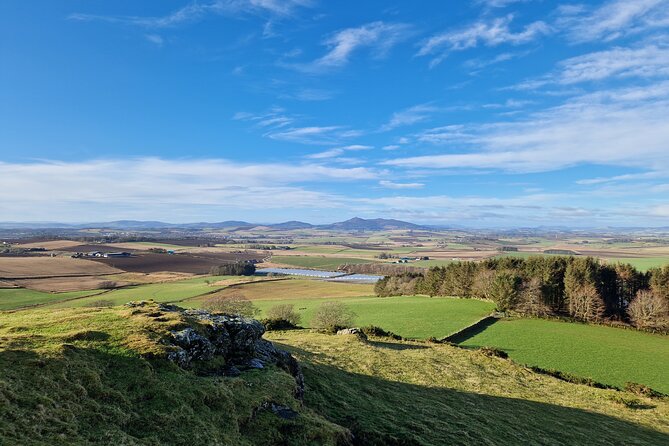
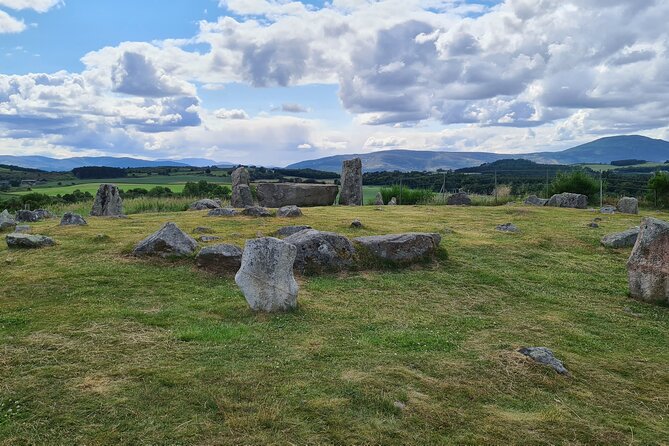
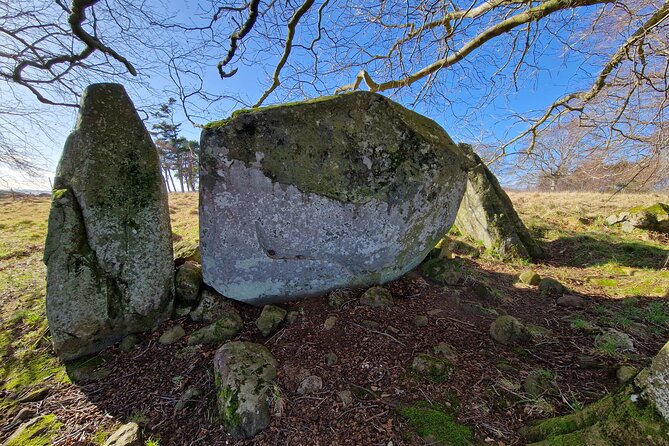
Tomnaverie is a recumbent stone circle, a type found only in northeastern Scotland. Its defining feature is a large stone laid on its side, with two upright stones beside it. Other standing stones complete the circle.
The arrangement is easy to picture, but its purpose is much harder to pin down. The circle is close to a burial cairn dating to roughly 4,500 years ago, placing it far earlier than the Pictish period. You can consider several theories about why people built such monuments, but no single explanation settles the matter.
That uncertainty is handled well by a tour built around folklore and interpretation. You get room to think about what the stones may have meant without being forced into a neat answer. The views also help. The setting gives the monument a clear relationship with the surrounding countryside, rather than treating it as an isolated object behind a fence.
The visit lasts around 30 minutes. It is a short stop, but it provides a strong final image for the day: a prehistoric monument, a burial place, and a wide view shaped by thousands of years of human activity.
Jacqueline’s flexible guiding style
Jacqueline is the named guide associated with this experience, and the strongest praise centers on her ability to adapt the day. She is described as making the outing personal, responding to requests, and adding local stops when possible.
That flexibility is useful for a tour of this kind. Archaeological sites do not all offer the same thing to every person. You may care most about Pictish symbols, hillfort construction, folklore, photography, castles, or the countryside itself. A guide who can change the emphasis makes the day more useful than a fixed script.
The extra places mentioned by past customers include a cliff above the sea, seabirds and puffins, a whisky brewery, and a castle. These should not be treated as guaranteed parts of the published route. Think of them as possible additions when the day allows, not promised inclusions.
The guide’s role is especially important because many of the sites are remains rather than complete buildings. Without context, a ditch can look like a ditch. With a clear explanation, it becomes part of a defensive system built by a community with its own politics, economy, and beliefs.
Price, group size, and what you get for $135.49
At $135.49 per person, this is not the cheapest way to spend a day around Aberdeen. The price makes more sense if you value transport between scattered rural sites, a small group, a specialist subject, and a guide who can adjust the experience.
The four known ratings are all five-star ratings, with particular praise for Jacqueline’s personal approach and for access to quiet, less-visited heritage sites. That does not remove the need to judge the tour on your own priorities. If you want a large attraction with displays, toilets, a café, and clear signage, this is not that kind of day.
The value is strongest for you if hiring a car would be inconvenient or if you would not feel comfortable finding remote hillforts and stone circles on your own. WiFi is included onboard, and the maximum group size of seven keeps the vehicle-based sections more personal.
Because lunch is extra and admissions are listed as free, most of your payment goes toward the day’s guiding, transport, planning, and small-group format. The tour is best seen as a specialist countryside experience rather than a package of paid attractions.
The tour is booked, on average, 64 days ahead. That suggests you should reserve early if your Aberdeen dates are fixed, particularly if you want the small-group format.
Walking, weather, and who should skip it
You need a moderate level of physical fitness. The hill sections include steep stretches, and the ground may be uneven. The tour is not recommended for people with mobility issues, although guests are not expected to take part in every walk and some adjustments can be made.
If you are unsure, contact the provider before booking. That is more useful than hoping the route will be easy on the day. Service animals are allowed, and the meeting point is near public transportation.
Weather matters. This experience requires good conditions, and poor weather can lead to a different date or a full refund. That policy is reassuring, but you still need waterproof clothing and sturdy shoes because even a dry forecast does not turn a hillfort into a paved attraction.
I would choose this day for someone who enjoys archaeology, folklore, open countryside, and places that require imagination. I would be more cautious about recommending it to someone with limited time in Aberdeen, limited mobility, or a strong preference for indoor attractions.
Cancellation and meeting point details
You meet at the William Wallace Statue on Union Terrace in Aberdeen at 9:00 a.m. The tour ends back at the same point.
You can cancel for a full refund up to 24 hours before the local start time. Changes made inside that 24-hour window are not accepted, and cancellations within that period are not refunded unless poor weather causes the provider to cancel the experience.
The ticket is mobile, so you can show confirmation on your phone. Confirmation is received when you book.
Should you book Aberdeen’s Ancient Heritage and Folklore?
Book it if you want to see the older, quieter side of Aberdeenshire and you enjoy having a guide explain why a few stones or earth banks matter. The combination of Barra Hill, Dunnideer, Rhynie, and Tomnaverie gives you a broad sweep from prehistoric monuments to Pictish power and later Scottish change.
The best reasons to go are Jacqueline’s flexible style, the very small group, and the chance to reach sites that are easy to miss without local planning. Bring lunch, prepare for hills, and keep your expectations focused on archaeology and setting rather than polished monuments.
Skip it if you want a relaxed sightseeing loop with little walking or if you need a guaranteed indoor program. For the right person, though, this is a thoughtful and unusually personal way to connect Aberdeen with the people who shaped its earliest story.
FAQ
Where does the tour start?
The tour starts at the William Wallace Statue on Union Terrace, Aberdeen, AB10 1NP.
What time does the tour begin?
The start time is 9:00 a.m.
Where does the tour end?
The experience ends back at the William Wallace Statue meeting point.
How long does the tour last?
The tour lasts approximately seven hours and 30 minutes.
What sites are visited?
The route includes Barra Hill, Dunnideer Hillfort, Rhynie, Bellabeg, and Tomnaverie Stone Circle.
Is lunch included?
No. You can buy lunch in Insch or Bellabeg, bring a picnic, or use the provided cooler for food you carry.
How many people can join the tour?
The tour has a maximum of seven participants.
Is the tour suitable for people with mobility issues?
It is not recommended for people with mobility issues because some hill sections are steep. Guests are not required to join every walk, and adjustments may be possible. Contact the provider before booking if you are unsure.
Should I bring walking poles?
Yes, if you use them. The tour includes steep sections, and some poles may be available to borrow on the day.
What happens if bad weather cancels the tour?
If poor weather causes cancellation, you will be offered another date or a full refund. You can also cancel for a full refund if you do so at least 24 hours before the start time.
Just added around Aberdeen
- St Andrews and Dundee Small-Group Tour from Aberdeen★ 5.0 · 11 reviews
- Speyside Whisky Trail Day Tour from Aberdeen Including Admissions★ 4.5 · 34 reviews
- Private Aberdeen City Walking Tour★ 5.0 · 6 reviews
- Private Balmoral Glamis Dunnottar Castles Tour from Aberdeen★ 5.0 · 3 reviews
- Aberdeen Historical Walking Tour★ 5.0 · 13 reviews
- Coastal Villages of Aberdeenshire★ 5.0 · 64 reviews
- Best Scottish Whisky Distilleries Private Tasting Trip plus optional Castle Tour★ 5.0 · 4 reviews
- Gin Tasting Masterclass in Aberdeen★ 5.0 · 13 reviews
Historical Tours, compared.
Old Town Walking Tour History and Tales in Edinburgh
Read our review →
Multi-Sensory Small-Group Historic Vaults Tour in Edinburgh
Read our review →
Edinburgh Old Town: Historical Guided Walking Tour
Read our review →


Browse the lists this tour appears in