
Reviewed · CITY TOURS
City Sightseeing Glasgow Hop-On Hop-Off Bus Tour
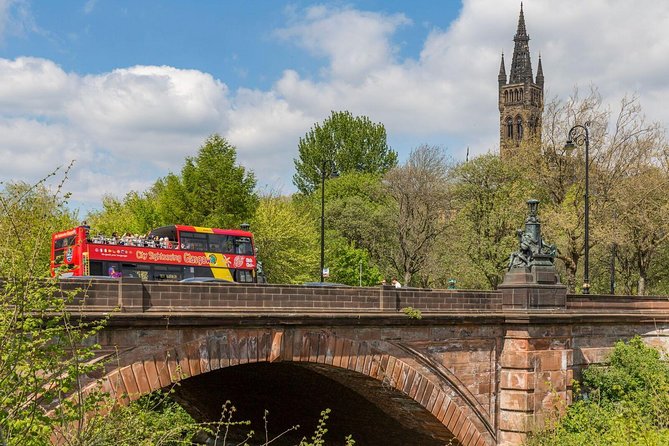
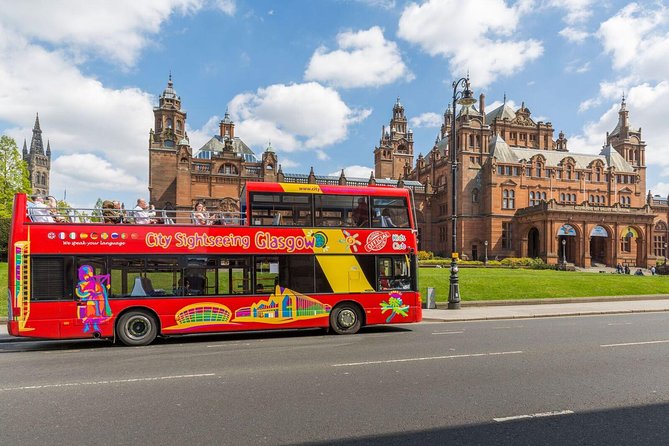
Glasgow’s two sightseeing bus routes give you a quick feel for a city that can seem spread out at first. The Red Route links George Square, the Cathedral, Merchant City, Kelvingrove Museum, the university, and the Riverside museums in about 90 minutes. The seasonal Yellow Route reaches further east and west, including Celtic Park, Ibrox, Govan, and the Science Centre.
I like the way the ticket lets you build your own day, using the bus for a full circuit first and then returning to the sights that catch your eye. I also like the mix of recorded commentary and occasional live guides, with guides such as Luke and Jim adding humor and answering questions. The main concern is reliability: temporary stop changes, missed pickups, and long waits can disrupt a tightly planned visit.
In This Review
- Key points for planning your Glasgow bus day
- Why the bus works well in Glasgow
- George Square to the Cathedral
- Merchant City, the Barras, and Glasgow Green
- St. Enoch, the city center, and the river
- Riverside Museum and the West End
- Kelvingrove, the School of Art, and Buchanan Street
- What the Yellow Route adds
- Recorded commentary or a live guide
- Timing, stop changes, and the main drawbacks
- Who should book this tour
- Should you book the Glasgow bus tour?
- FAQ
- How long is the full Red Route?
- How often do Red Route buses run?
- What time does the Red Route begin?
- What time is the last Red Route departure?
- When does the Yellow Route operate?
- What time does the Yellow Route begin and end?
- How long is the ticket valid?
- Are the audio guides available in several languages?
- Does the ticket include attraction admission?
- Can I cancel for a full refund?
Key points for planning your Glasgow bus day
- Two routes cover different sides of Glasgow: The Red Route runs all year, while the Yellow Route operates from April 4 through September 29.
- Live guides can make a big difference: Red Route live commentary is offered from April through September, with Luke and Jim singled out for clear, entertaining presentations.
- The full Red Route takes about 90 minutes: Use it as an orientation ride before deciding where to get off.
- The upper deck gives the best views: It is also more exposed to Glasgow’s changeable weather and outside noise.
- Stop information can change: Stop 1 and several other stops have temporary arrangements, so check the current boarding point before you wait.
- The ticket is good for one or two calendar days: It begins with your first use, not necessarily when you book.
Why the bus works well in Glasgow
Glasgow is easy to enjoy once you know how its parts connect, but its museums, parks, music venues, university quarter, and riverfront are not all clustered together. A sightseeing bus saves you from piecing together every move and gives you a broad view before you spend time inside individual attractions.
The Red Route is the core experience. It runs all year, with the first bus leaving Stop 1 at 10 a.m. and the last leaving at 4 p.m. Buses are scheduled about every 30 minutes, and the full circuit takes roughly 90 minutes. That makes it useful for a short visit, especially if you have only one day in town.
The ticket costs $27.62 per person. The value depends on how you use it. If you stay on for one complete circuit, you are paying for orientation and commentary. If you hop off at several places and use the bus for later connections, the price becomes easier to justify. The one or two-day option is particularly helpful if you want a relaxed first day rather than a forced dash between sights.
I would use this bus early in your Glasgow visit. Take the full Red Route, note the places you want to revisit, then spend the rest of the day exploring two or three stops on foot. The bus is not a substitute for Glasgow itself. It is a useful way to decide where to spend your limited time.
A few more Glasgow trips to weigh up
- Glasgow City Centre Walking Tour with Local Guide
★ 5.0 · 1,326 reviews - Merchant City Music Walking Tour of Glasgow
★ 5.0 · 94 reviews - Glasgow City and Clyde Bridges Bike Tour
★ 5.0 · 91 reviews
George Square to the Cathedral
The main Red Route begins around George Square, with Stop 1 listed at George House. The square is a sensible starting point because it puts you near the city center and gives you an immediate look at Glasgow’s grand civic architecture.
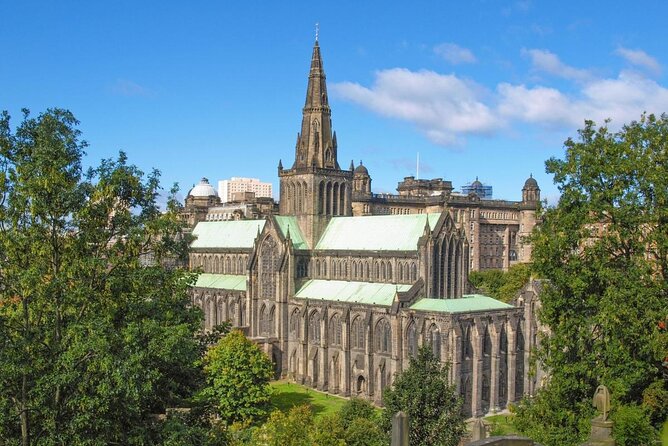
At Stop 2, Cathedral Square, you are close to Glasgow Cathedral. This is one of the strongest early stops for a short visit. The cathedral is a major medieval building, and the surrounding area helps you understand the older side of the city. Stop changes matter here, though. Current operating information places Stop 1 on Cathedral Street, in front of the Charles Oakley Building, for pickup and drop-off only, while Stop 7 on St. Vincent Street serves as the main starting and ending point.
Do not assume the stop names in your booking app will always match the street situation. Several stops have been moved or temporarily closed. If you are beginning near the Cathedral, look for the bus and confirm with the driver before settling in for a wait.
Merchant City, the Barras, and Glasgow Green
The Red Route continues to Blackfriars Street for Merchant City. This is a good stop for streets lined with older buildings, restaurants, shops, and city-center architecture. It is also a practical place to break the bus ride with a walk.
The next part reaches The Barras, Glasgow’s famous market area, via the stop on London Road. From there, the bus continues toward Glasgow Green. These stops show a less polished and more everyday side of the city than the formal center. The Barras is tied to Glasgow’s market and music culture, while Glasgow Green offers open parkland close to the center.
The Yellow Route gives this eastern side more attention. Its stops include High Street for Merchant City, Barrowlands, Celtic Park, Bridgeton, West Brewery, The Barras, and McLennan Arch. If you have a strong interest in football, music, markets, or the east end, the Yellow Route is more useful than simply repeating the Red Route.
One caution: the two routes overlap. A full Yellow Route afternoon can repeat some of the central Glasgow material from the Red Route. I would not automatically spend a whole day on both. Choose the Yellow Route for its extra districts, not because every minute will bring a new sight.
St. Enoch, the city center, and the river
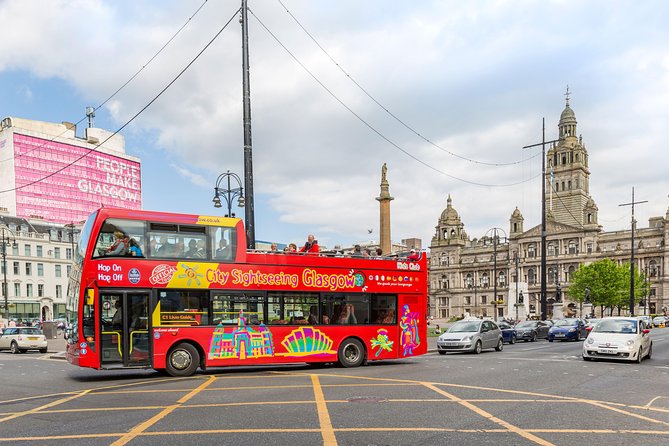
The Red Route’s central stops include St. Enoch Centre, St. Vincent Place, Oswald Street, and Argyle Street. These are handy for shopping, city-center walks, and changing your position without retracing your steps.
The route then moves toward the Clyde, stopping near the Hilton Garden Inn, the SEC Centre, and Clydeside Distillery. This is where Glasgow’s industrial and modern identities meet. The SEC Centre handles major events, while the distillery offers a paid attraction for visitors interested in whisky. Admission to attractions is not part of the bus ticket, so plan extra time and money if you want to go inside.
The river section is more valuable as a connected view than as a single must-see stop. You can watch the city shift from central streets to the Clyde’s redevelopment zone. The recorded commentary helps explain what you are seeing, and a live guide can add useful context when one is operating.
The Yellow Route includes Broomielaw, Finnieston Quay, and the Science Centre. These stops make that route worthwhile for anyone interested in the riverfront, science, or modern Glasgow. The Science Centre and nearby attractions need separate admission.
Same glens and lochs, a completely different day out:
- Guided Celtic Park Stadium Tour
★ 5.0 · 3,136 reviews - Oban, Glencoe, Highlands Lochs & Castles Small Group Day Tour from Glasgow
★ 5.0 · 1,432 reviews - Loch Ness & the Highlands Day Tour from Glasgow Including Cruise
★ 5.0 · 1,211 reviews - Celtic Park Tour & Dine Package
★ 5.0 · 998 reviews
Riverside Museum and the West End
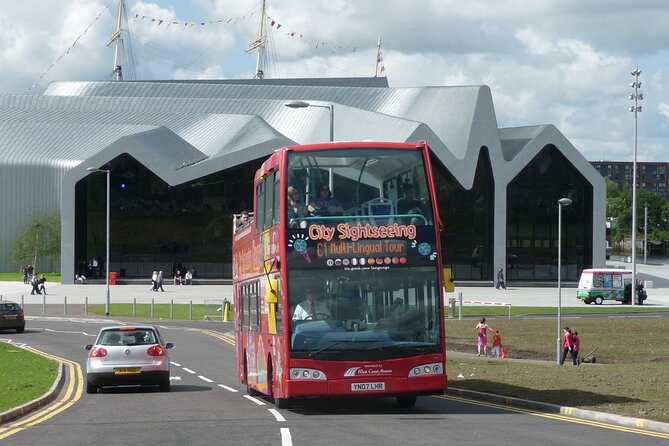
Stop 13 on the Red Route serves the Riverside Transport Museum. This is one of the best places to leave the bus. The museum is a major draw for transport fans, but it also gives you a clear sense of Glasgow’s working past through vehicles and transport displays.
From the Riverside area, the route heads toward Woodlands Road, the University of Glasgow, Byres Road, Kelvingrove Museum, and the hotels on Sauchiehall Street. This is the most rewarding stretch for many first-time visitors because it connects several of Glasgow’s strongest cultural stops.
The University of Glasgow stop is useful for the university quarter and its striking buildings. Byres Road gives you access to the West End’s shops and cafés, while Kelvingrove Museum is one of the city’s essential indoor stops. The bus does not include museum entry, but it drops you close enough to make a visit practical.
Kelvingrove is also a smart weather backup. Glasgow can turn wet quickly, and an indoor museum gives you somewhere substantial to spend time while the upper deck becomes less appealing. If you have only one stop for a longer break, I would choose Kelvingrove or the Riverside Museum over a quick photo stop in the center.
Kelvingrove, the School of Art, and Buchanan Street
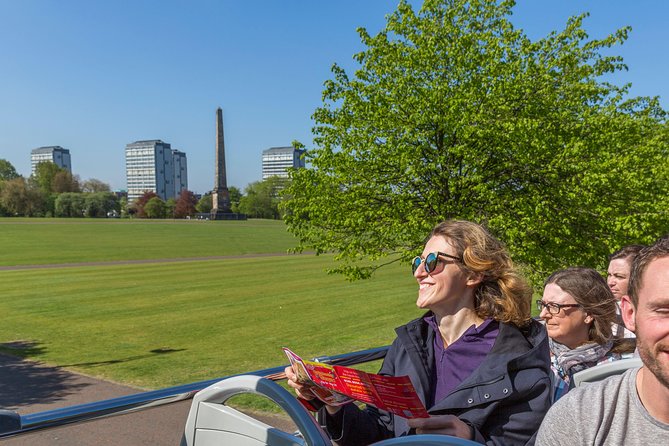
The Red Route continues through Kelvingrove Hotels, Charing Cross, the Glasgow School of Art, the Royal Scottish Academy of Music and Drama, and Buchanan Bus Station. This section is convenient for seeing the city’s cultural institutions without walking across the entire center.
The School of Art stop is especially useful for architecture fans. The route also passes near the Royal Scottish Academy of Music and Drama, now associated with the Royal Conservatoire of Scotland. These are brief exterior views from the bus unless you arrange a separate visit.
Buchanan Bus Station is the final listed stop before returning to George Square. It is practical if you are connecting with other city transport, but it can be busy. Stop 1 is also known to fill up, so starting at another active stop can be easier when service allows.
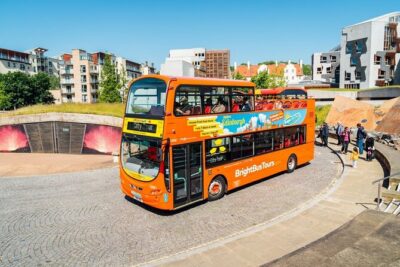
The upper deck offers the clearest views of buildings and street scenes. Sit upstairs if the weather is dry, but bring a waterproof layer and expect some road noise. One problem with the open design is that recorded announcements can be difficult to hear when traffic and wind are loud. Free headphones are provided on the Red Route, and they are worth using.
What the Yellow Route adds
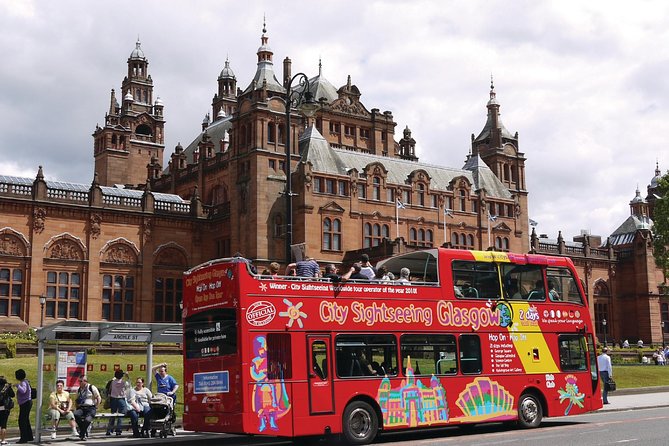
The Yellow Route operates only during high season, from April 4 through September 29. Its first departure from Stop 1 is scheduled for 9:45 a.m., with the last at 4:15 p.m. It uses electric buses, which makes the ride quieter in some sections and gives this route a different feel from the standard Red Route.
The eastern side includes Tennent’s Brewery, High Street, Barrowlands, Celtic Park, Bridgeton Bandstand, West Brewery, The Barras, and McLennan Arch. Celtic Park is the obvious reason for football fans to choose this route. The Barras and Barrowlands bring you closer to Glasgow’s music and market culture.
The route then heads west through Broomielaw, Finnieston Quay, the Science Centre, Govan, Fairfield, Ibrox Stadium, the SEC Centre, Clydeside Distillery, Riverside Museum, Kelvingrove Museum, the Hidden Lane, Blythswood Square, and Nelson Mandela Place.
I would choose the Yellow Route if you want to see Ibrox, Celtic Park, Govan, or the Science Centre. I would skip it if your visit is short and your main goals are the Cathedral, Kelvingrove, the university, and the central museums. Parts of the two routes repeat, and the second ride can feel less fresh if you have already heard the same commentary.
Recorded commentary or a live guide
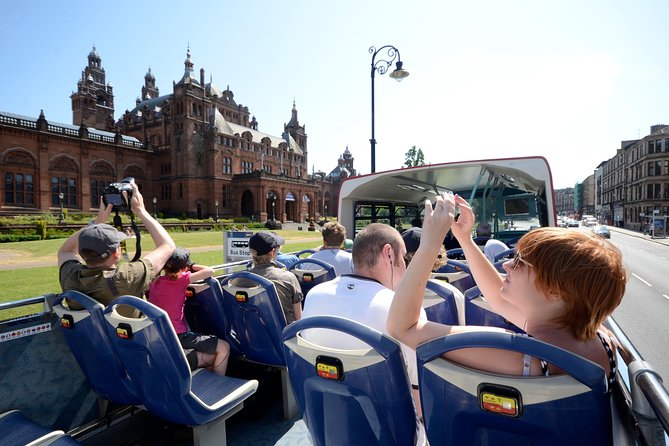
The Red Route includes audio commentary in seven languages, with free headphones. The Yellow Route uses an English audio guide. The recorded material is clear and useful for learning about the buildings, neighborhoods, and major sights without hiring a separate guide.
When a live guide is aboard, the experience can be better. Luke is praised for mixing facts and humor at a comfortable pace, while Jim is known for turning the circuit into an informal introduction to Glasgow and taking questions. Live commentary is scheduled on the Red Route from April through September, with the current update extending availability through October 19, 2025.
Live narration is not guaranteed on every departure, so do not book solely on the assumption that a particular guide will be present. Still, it is worth asking at boarding. A good guide can explain what you are passing in a way that feels more connected to the city than a fixed recording.
Timing, stop changes, and the main drawbacks
The published frequency is every 30 minutes on the Red Route, but real service can be affected by traffic, construction, stop changes, and the end of the operating day. Some departures from Stop 7 at 3:30, 4, and 4:30 p.m. terminate on Cathedral Street instead of completing the full route.
That makes a late start risky. Begin before 2:30 p.m. if you want a full circuit and time to hop off. Starting at Stop 1 is not always best, however, since it can be crowded and may operate only as a pickup and drop-off point during current changes.
One stop is temporarily out of use, and other stops have been relocated. Stop 8 remains on Jamaica Street outside Lidl, while Stop 9 is temporarily closed. You may also need to flag down a bus or signal clearly at certain stops rather than assuming the driver will stop automatically.
This is the tour’s biggest weakness. The bus can be excellent once you are aboard, but poor stop communication can leave you waiting in the rain. Keep a backup plan. Know the next stop on your route, carry the address of your destination, and avoid scheduling a timed attraction immediately after a bus connection.
Who should book this tour
I would recommend the Red Route to first-time visitors, people with limited time, families who want a simple overview, and anyone who finds Glasgow’s districts hard to connect. It is also useful if walking long distances is not appealing, though the tour still requires you to get on and off at street stops.
The tour suits you best if you enjoy looking at a city from above and choosing your own stops. It is less suitable if you need exact departure times, guaranteed pickup at every listed stop, or a quiet ride focused on photography.
Use the one-day ticket for an orientation ride plus two or three stops. Pick the two-day ticket if you want museums and neighborhoods at a slower pace. Mobile and paper vouchers are accepted, and vouchers remain valid for 12 months from the selected travel date, but the sightseeing pass itself begins with first use and lasts for one or two consecutive calendar days.
Free cancellation is available until 24 hours before the start time. Cancellations within 24 hours are not refunded, and poor weather may lead to a date change or full refund.
Should you book the Glasgow bus tour?
Book it if you want a practical first look at Glasgow and plan to use it as transport between major sights. The Red Route offers the best all-round value, especially when you ride the entire loop, use the upper deck in good weather, and get off at Kelvingrove, the Riverside Museum, the Cathedral, or the university area.
Add the Yellow Route for Celtic Park, Ibrox, Govan, the Science Centre, Barrowlands, and the east end. Do not expect two completely separate sightseeing experiences, since the routes overlap.
My advice is simple: start early, check stop changes on the day, ask which buses have live guides, and leave room in your schedule for delays. With those precautions, the tour is a useful Glasgow primer. Without them, a missed bus or changed stop can cost more time than the ticket saves.
FAQ
How long is the full Red Route?
The full Red Route takes about 90 minutes.
How often do Red Route buses run?
Red Route buses are scheduled approximately every 30 minutes.
What time does the Red Route begin?
The first Red Route tour from Stop 1 is scheduled for 10 a.m.
What time is the last Red Route departure?
The last Red Route tour from Stop 1 is scheduled for 4 p.m.
When does the Yellow Route operate?
The Yellow Route operates during high season, from April 4 through September 29.
What time does the Yellow Route begin and end?
The first Yellow Route departure from Stop 1 is scheduled for 9:45 a.m., and the last is scheduled for 4:15 p.m.
How long is the ticket valid?
You can buy a ticket valid for one or two consecutive calendar days from the time of first use.
Are the audio guides available in several languages?
The Red Route offers recorded commentary in seven languages and provides free headphones. The Yellow Route offers an English audio guide.
Does the ticket include attraction admission?
No. Entry to attractions, along with food and drinks unless specifically stated, is not included.
Can I cancel for a full refund?
Yes, if you cancel at least 24 hours before the experience start time. Cancellations made within 24 hours are not refunded.
Just added around Glasgow
- Private Tour of Glasgow Distilleries and a Loch Lomond Cruise★ 5.0 · 13 reviews
- West of Scotland Cultural Tour★ 5.0 · 7 reviews
- Ultimate Day tour Edinburgh: Glencoe, Highland Cows, Loch Lomond★ 5.0 · 10 reviews
- The Braveheart tour from Glasgow or Edinburgh★ 5.0 · 6 reviews
- Scottish Highlands, Lochs & Castles from Edinburgh and Glasgow★ 5.0 · 6 reviews
- Shore Excursion to Loch Lomond & Stirling Castle★ 5.0 · 10 reviews
- The Scottish Highlands Photography Tour & Workshop★ 5.0 · 3 reviews
- Loch Ness and the Scottish Highlands from Glasgow or Edinburgh★ 5.0 · 10 reviews
City Tours, compared.
City Sightseeing Edinburgh Hop-On Hop-Off Bus Tour + Kids Go Free
Read our review →

Edinburgh City Bike Tour – Choice of E-Bike or Manual
Read our review →

Big Bus Edinburgh Hop-On Hop-Off City and Britannia Bus Tour
Read our review →
City Sightseeing Inverness Hop-On Hop-Off Bus Tour
Read our review →Browse the lists this tour appears in